
GHOST TOWNS

Updated: Aug 19
Part 1
Stories by Robert Martinez

This issue covers our local history of ghost towns. Back in the 19th century and earlier part of the 20th century there were many small hamlets and villages that dotted the Hernando County map. Here is the history of those ghost towns, along with their post offices and a few maps to guide your toward their location. You can have a lot of fun with this issue exploring the county looking for these old spots and imagining what life must have been like.
Ghosts In The Woods!
From the very beginning of Hernando County in the 1840s, there have been many small villages and hamlets that have dotted the county maps. During the 1800s and the early part of the 20th century, a trip of five to ten miles was considered an arduous trek for many, especially considering the condition of the roads, which in many cases were nothing more than a dirt path. Instead of having to take a horse and buggy or go on horseback all the way to Brooksville, many enterprising people built general stores, started post offices and began small communities that shared a church, general store, small school and a blacksmith. Some sprang up out of necessity from mining, timber and turpentine interests. Some of them thrived. Consider the fate of Centralia, which was a timber, turpentine and lumber community that grew to a population by 1912 of over 2,000 inhabitants, only to become a ghost town ten years later due to the exhaustion and depletion of all the timber in western Hernando County. It had its own restaurant, huge general store, movie theatre and other amenities, making it a city almost on a level with Brooksville.
There were many other small hamlets in the woods that provided homes and comfort instead of having to get back home from Brooksville on horseback or buggy after a hard day's work to buy food, a newspaper, milk or loaf of bread. With the exception of Nobleton, Masaryktown and Centralia, none were started by developers, but by the citizens who lived, worked and toiled to eke out a living there. We list those post offices that existed as well. There was no internet, direct deposits or credit cards. Just cold, hard cash, checks and the mail. The local post office was the meeting place for all the news and local gossip. Here is our list of ghost towns.
The Ghost Towns
Add
Add was a small community just north of Lake Lindsey, another small hamlet that began around 1852 and still exists today. Add was located along where Snow Hill Road is today. It was named after Addison McKeown, who was postmaster there. It had a grist mill, cotton gin, blacksmith, citrus groves and a tannery. The post office closed in 1894, but folks still referred to that area well into the 20th century.
Postmaster - Addison McKeown - October 8, 1884 - July 12, 1894
Discontinued in 1894 with services forwarded to Brooksville

Rare tintype (1884) of the Add post office/general store.
Add was located just north of Lake Lindsey
Addison McKeown, Postmaster, stands on the front porch
Augusta
Augusta was a short-lived community about seven miles northwest of Brooksville that was established with a post office and a stagecoach station in 1854 and discontinued on October 17, 1860 after Postmaster Albert Clarke was killed by one of his slaves, Hamp. Mr. Clarke was killed on October 1, 1860. It was later learned that Hamp was paid $200 by Clark's son-in-law, James Boyd and Mrs. Clarke for the job of killing Mr. Clarke. Hamp was hanged for his crime on October 13, 1860. James Boyd was also arrested and sent to the penitentiary for life.
Postmaster - Albert Clarke - January 31, 1854 - October 1, 1860
Discontinued after October 17, 1860 after the death of Clarke

1880 map by Hardesty shows Augusta in relation to Brooksville. Augusta would close down its post office in 1860 after the murder of its postmaster Albert Clarke. It still remained as a stagecoach stop along with Ft. Taylor. The village of Pemberton's Ferry was named after a Mr. Pemberton who operated a ferry service across the Withlacoochee from 1878 on. In 1882, it would rename itself Istachatta again.
Centralia
The most famous of ghost towns in this area is Centralia. In existence from 1908 until 1922, it at one time boasted a population of over 2,000. It was a thriving sawmill community surrounded by 15,000 acres of red tidewater cypress and long leaf pine.
The Central Cypress Company was the heartbeat of the town. A town of men and mules, clanging log trains and lots of mosquitoes. It had a cosmopolitan work force, however, with many arriving from such far off lands as Greece, Germany, Ireland, Scotland, England, Spain and France. Celebrations all had an international flavor. The post office was in operation from 1910 until 1922, and there was also a 24-hour restaurant, "The Hungry None." It had one school and one church. They had their own movie theatre "The Flicker Palace" and the local commissary was the nucleus of the town, supplying groceries, dry goods and hardware, drawing customers not only from Centralia but from Brooksville, Inverness, Bushnell and Dade City. It was the largest retailer between Tampa and Jacksonville. The sawmill cut an average of 100,000 board feet a day.
Dr. Johnson was the town doctor, Dr. Hedick from Brooksville was the dentist, and Jack Amstutz, also from Brooksville, sold Fords to its residents. Although the community continued to thrive, unfortunately there was no future plan, and when the timber ran out, the future was now here, and it wasn't pretty. When the mill closed down in 1917, the daughter of Boss Roberts pulled the lonesome sound of the whistle for the last time. Men stood with dirty grim faces, the women wept and dogs howled, and then they all left and it was gone. By 1922, Centralia was a ghost town, but for a while, some could still hear the ghosts of Centralia dancing under the Gulf moon light.
Postmaster - Edgar Roberts - June 10, 1910
Duncan McArthur - December 3, 1918 - 1922

A group of Centralia residents (1912) show off their Sunday best during an outing. Centralia was a vibrant lumber community with a population of nearly 2,000. Located about 15 miles northwest of Brooksville, within ten years it would be a ghost town.

The huge Centralia Commissary General Store (1913).
Open from 6 am until 10 pm. The train would roll up in front of the store. It was one of the grand stores in Florida carrying more retail stock than any store in either Tampa or even Jacksonville. "From the cradle to the grave" was their motto. Large barrels of produce, sugar, flour, soft drinks and clothing from all over the world would arrive by train daily. On Monday mornings, salesmen would arrive with all their wares.
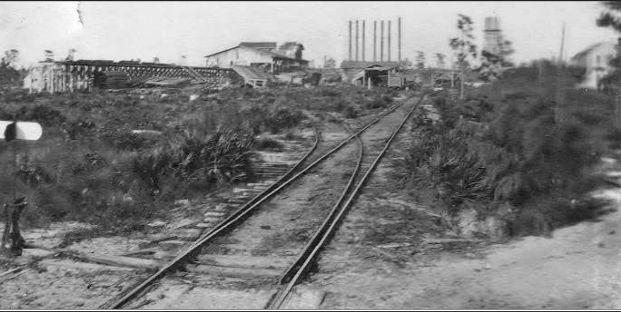
Centralia Train (1912)
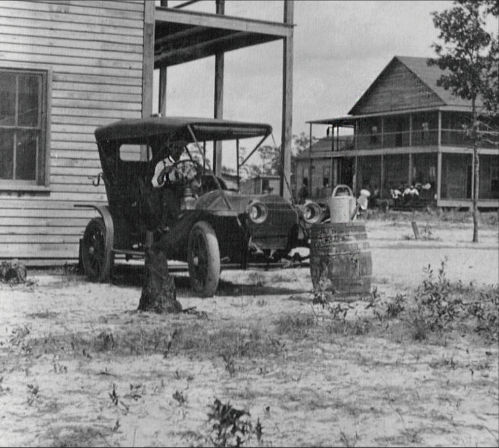
1915 Centralia parking next to the Flicker Palace movie theatre
Crayhead
Crayhead was established on December 14, 1895, and changed its name to Spring Lake on July 31, 1896. The post office was discontinued on April 30, 1909 and forwarded to Brooksville. The small community grew thanks to citrus and its many groves. There is an old cemetery there that features old area names such as Lee, Harville and Daniel. Lee's Store was a oasis there at the corner of Power Road for 50 years.
Postmasters
Manning Roundtree - December 14, 1895 - December 31, 1896
Lewis Lee - February 1, 1897
Andrew Hortel - April 8, 1902
Martin Lee - August 27, 1903 - April 30, 1909
Croom/Fitzgerald
Croom was located 10 miles east of Brooksville. If one wants to travel that same area today, the best way is to take Croom Road just north of Brooksville and proceed east for 10 miles and then pass the bike trail near I-75. Proceed around the sharp curve and on your right is where the old Croom School was. Go another 1/4 mile and you'll be in the area where the gas station/general store was. Another 1/4 mile on your right is where the Croom train station was.
The settlement was originally known as Fitzgerald in 1893. The name was changed in 1902. It was named after Alonzo Croom, one of its most influential residents, who served as State Comptroller from 1901 to 1912. During its early years it was a vital stop for Tampa's Plant Railway System and a short line would run from Croom to Brooksville. Many blacks worked there in railroad jobs and were a large segment of the early settlement. The turpentine industry also provided much work.
The general store that began in 1915 was owned by Leroy McKeown. He also owned the gas station and about 50 acres with cattle. In 1932 the turpentine dried up, and the city lost much of its population. Then a severe depression in the 1930s and World War II ended Croom as a town and its once glorious dreams.
Postmasters
Clark Williams - February 23, 1893
David Sprecher - April 30, 1900 - October 20, 1920
Ernest Johnson - October 20, 1922
Riley Smith - July 18, 1923
Weston Peach - March 25, 1925
Hattie McKeown - May 2, 1925 - January 1935
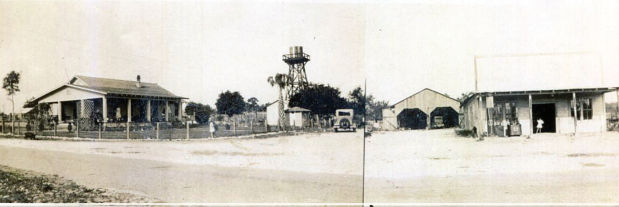
A panoramic view of Croom, circa 1925. A small forgotten village east of Brooksville
The house on the left and gas station/store were owned by Leroy McKeown, who also owned about 50 acres and many cattle. He had a vision that Croom would become a major stop on the highway, but in 1932 the turpentine industry dried up. Mr. McKeown was killed in an auto accident in 1934. The Great Depression and World War II following, left Croom a thing of the past by 1945.
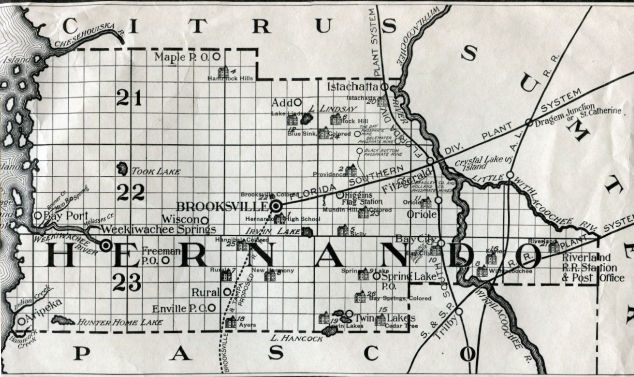
1900 Hernando County map shows a few of the old ghost towns like Add, Enville, Wiscon, Oriole, Fitzgerald (which would soon be named Croom), Freeman, Twin Lakes and Took (sic) Lake.
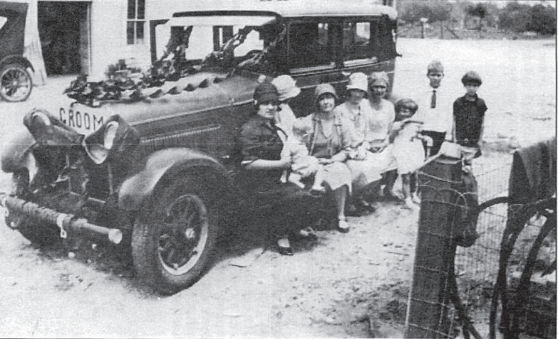
Croom outing on a Sunday morning (1926)
Oriole
A timber and lumber community begun by Captain John Grisham, it was established on June 9, 1884, and discontinued on March 4, 1904. Gidden's or Oriole Cemetery is around there. Located just northwest of Ridge Manor and just west of 301.
Postmasters
Martin Horning - June 9, 1884
David Robarts - April 24, 1896
Isaac Talley - April 25, 1888
G. C. Smullin - April 11, 1895
Robert Frost - July 8, 1895
David Sprecher - October 30, 1895
Henry Giddens - November 27, 1897
Robert Frost - January 4, 1897
John Hamilton - November 26, 1897
Benjamin Mountain - March 21, 1898
Istachatta/Pemberton's Ferry
Istachatta is one of the county's earliest settlements with George Peters settling here in 1842. A post office was opened on May 29, 1878, when the town became known as Pemberton's Ferry, named after James Pemberton who offered ferry rides across the Withlacoochee. In 1881, the town became Magnolia, then in 1882 changed back to Istachatta and remains that today. It is located about 12 miles northeast of Brooksville.
Postmasters
James Pemberton - May 28, 1878 (Pemberton's Ferry)
P.M. Crawford - August 5, 1881 (Pemberton's Ferry)
Francis Townsend - August 8, 1881 (Magnolia)
Changed back to Istachatta in 1882
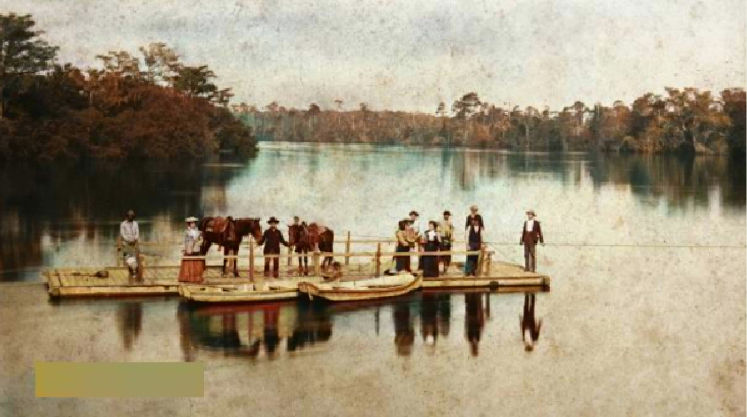
1878 photo of Pemberton's Ferry crossing the Withlacoochee River, east of Brooksville. The village was known as Pemberton's Ferry from 1878 to 1881 because of Mr. Pemberton's Ferry rides, then changed to Magnolia (1881) and then back to Istachatta (1882), its original name from 1842.
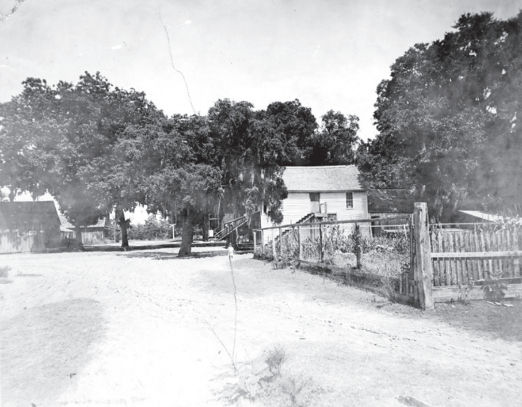
1918 Istachatta
You can almost hear the quiet. Istachatta in 1918 had changed little from the 19th century
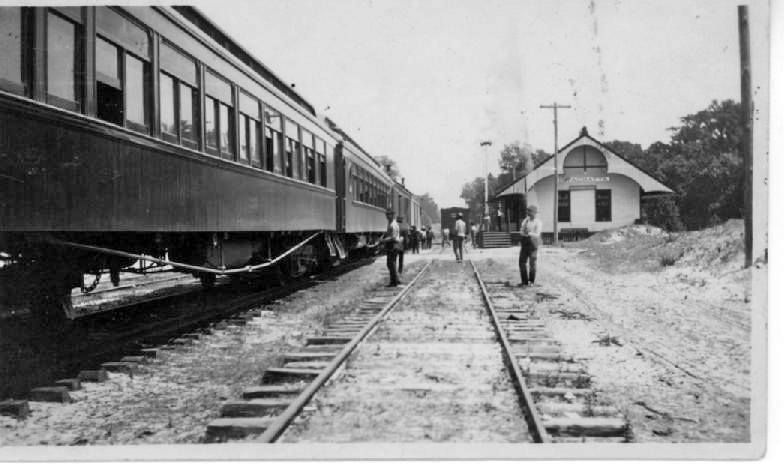
Waiting for a train. Istachatta train depot (1911). Istachatta was on the same line that also stopped in nearby Croom, Kaylon and Riverview
Delphos
Delphos was a mining camp with a population of around 200 about six miles north of Oriole, which is about where Ridge Manor (US 301) is today. It was established on September 29, 1891 and discontinued on April 23, 1894.
Postmaster
LaFayette Vorce - September 29, 1891
Enville
Enville was a lumber community that began in 1898 with various lumber companies through the years. Located just north of Masaryktown about seven miles south of Brooksville (about where Swiftmud is today). The town faded away during the early 1920s.
Postmasters
James Crosby - May 25, 1898
Virgil Chisom - December 1, 1899
Amanda Chisom - May 23, 1900
Amy Brown - May 20, 1901
James Weeks - June 4, 1910
Mimi Gaurganious - December 29, 1924
Mary Bell - February 23, 1913
Samuel Denton - September 13, 1917
Discontinued January 31, 1922 and referred to Powell
Freeman
Freeman was another sawmill/turpentine community named after Emma Belle Freeman in 1901 and existed until 1910. About 10 miles west of Brooksville, two miles east of Weeki Wachee.
Postmasters
Emma Belle Freeman - January 10, 1910
James Burgess - January 6, 1903
Lewis Petteway - January 26, 1906
Discontinued August 10, 1910

Lewis Petteway looks over his timber and turpentine business at Freeman (1906). Mr. Petteway was also the postmaster of Freeman from 1906 to 1910.
Powell
Powell was another small Hamlet that thrived in the lumber business. It was located where Powell Road is today, just west of Highway 41 about five miles southeast of Brooksville. Established April 4, 1912 and discontinued April 15, 1922.
Postmasters
Millard Thompson - April 4, 1912
Lera Shearer - March 4, 1914
Sallie Perkins - May 25, 1920
Tooke Lake
Tooke Lake was a village that really was a suburb of Centralia. It was a railroad town created by Mr. Roberts, the boss of Centralia. Its purpose was to haul supplies to the commissary, passengers, and recreational outings. The train would then back up from Tooke Lake to Centralia. The town existed along with Centralia from 1908 to 1922.

The Hamlet of Tooke Lake (1913) was really a suburb of Centralia in northwest Hernando County. A railroad town tying the Tampa Northern Railroad hauling supplies to the commissary, passengers and recreational needs to Centralia. The train would then back up on a short line from Tooke Lake 2 1/2 miles to Centralia. Its existence depended on Centralia from 1908 to 1922.
Wiscon
Wiscon was originally settled by residents from Wisconsin that wanted a nice, safe settlement without the sin. Hence, they named the town Wiscon. Settled in 1884, it was discontinued on July 20, 1910. At one time the population was 500-700.
Postmasters
Charles Peck (founder) February 18, 1884
James Ray - February 15, 1902
Quitman Varn - October 3, 1903
Henry Even - November 11, 1907
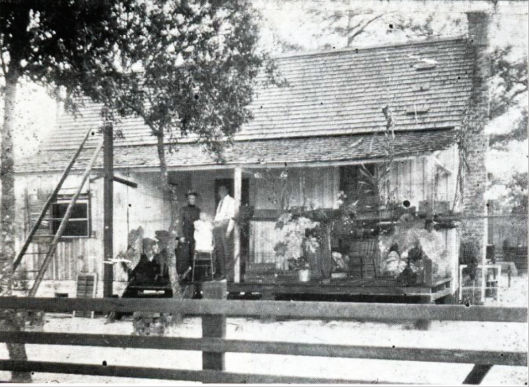
Wiscon home (1903) belonging to Quitman Varn, who served as postmaster from 1903 to 1907. Wiscon was about five miles west of Brooksville from 1884 to 1910.
Twin Lakes
Largely a black settlement, Twin Lakes was a small citrus and turpentine area that was established on August 29, 1884 and discontinued on January 29, 1895.
Postmasters
William Jackson - August 28, 1884
John Reilly - October 19, 1889
Charles Gregg - October 30, 1894 - January 29, 1895

The Twin Lakes School (1892). Twin Lakes was a citrus and working class community just north of Pasco County and South of Spring Lake in Hernando County from 1884 to 1895.


Comments