
Let's Go To The Movies!

Updated: Sep 2
A History of Brooksville's Theatres

The history of movie theaters in Brooksville began in 1909. Florida actually had movie studios back then with one of the biggest, the Lubin Company, in Jacksonville from 1910 - 1913. A young Oliver Hardy (later of Laurel & Hardy fame) worked there in 1912. The northeast's early movie moguls preferred Florida because of the weather, but soured on that because of the intense heat, rain, bugs and humidity and soon moved to California, where the landscapes and weather were more desirable.
Thanks to the following for their contributions
John White
George Allen Jr.
Eddie Muller


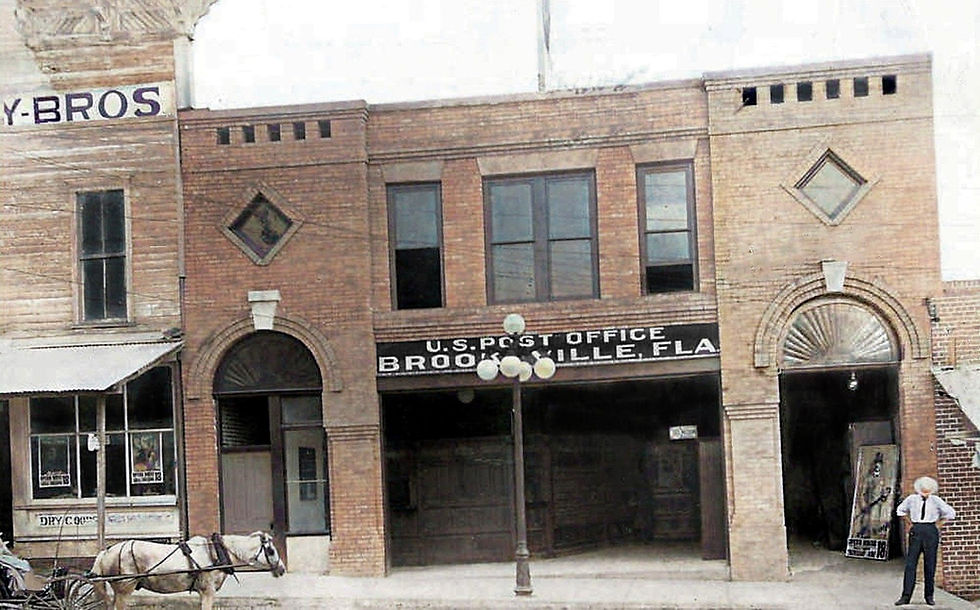


The Star Theatre began in 1914 on N. Brooksville Avenue and was the first theatre to feature motion pictures. They also had live plays. By 1915-1916 a new star was sweeping America and the world, Charlie Chaplin. His comedies revolutionized the movie industry internationally. Playing his immortal role of The Tramp with a heart of gold, by 1916 he signed a contract for 12 short comedies with Mutual for the outrageous sum of $650,000 at a time when the average man made $600 a year. Theatres also began showing full length features such as Birth of a Nation (1915) and Intolerance (1916) by D.W. Griffith.


The Victory Theatre was the third theatre in Brooksville, first opening in late 1923. Located on N. Main Street, directly across the street from the court house, it was owned by the team of Hawkins and Hudson, who owned several theatres on the west coast including, Inverness, Bushnell, Homosassa, Williston, High Springs and Dunnellon.
In late 1926, Hawkins and Hudson moved to a new location on East Broad (next to Enchilada's) later to be named the Dixie Theatre. It was called the Victory Theatre until 1932 when it was sold to new owners, Mr. and Mrs. Morrison and the name was changed to The Dixie. Earlier, before 1932, the building closed down for a while while converting to sound movies. Up until that time, all movies shown in Brooksville were silent, some with just a music track in the background, but there were many films shown at the Victory that were memorable, among them, Charlie Chaplin's City Lights (1931), Safety Last with Harold Lloyd (1924), Ben-Hur with Ramon Navarro (1926) The General with Buster Keaton (1926) and Wings (1927), the first Oscar Best Picture winner with a young Gary Cooper. All classics of the silent era.



The first lines spoken in a "talkie" by Al Jolson in the Jazz Singer (1927) - were "Wait a minute, wait a minute. You ain't heard nothin' yet."

The legendary Dixie Theatre officially began in 1932 when Mr. and Mrs. Morrison of Clermont purchased the theatre from Hawkins and Hudson. Despite the change over to sound movies, the Dixie had a rough time during the Great Depression. Many folks could not afford the luxury of movies, records, etc., so many turned to radio for their entertainment. They did manage to stay open, despite closing in 1937 for renovations and a new owner, Howard Smith, who would reopen the theatre in 1938 and also later start the 41 Drive-In around 1950. In a 2000 interview conducted with the 91 year-old Smith, he recalled "the first movie we had was The Crowd Roars with Robert Taylor. We had a tremendous turnout. You'd get a comedy, newsreel, cartoon and a movie for 25 cents." The Dixie had a fire in 1941 but reopened the following year. It would close around 1965.


The Classic 41 Drive-In Movies


Support Your Local Gunfighter
Elvis - Jailhouse Rock, King Creole, Blue Hawaii, Follow that Dream, G.I. Blues, Viva Las Vegas
Kentucky Fried Movie
John Wayne - Rio Bravo, McClintock, North to Alaska, True Grit, The Shootist, The Man Who Shot Liberty Valance
Cheech & Chong's Up in Smoke
Gidget Goes Hawaiian
Blue Denim - Troy Donahue, Sandra Dee
Pillow Talk - Rock Hudson, Doris Day
Beach Blanket Bingo - Frankie & Annette
Blazing Saddles
Hitchcock's Psycho, The Birds
Cool Hand Luke
The Blob
A Summer Place
Bonnie & Clyde
Easy Rider
Billy Jack
Dirty Harry Movies
Woodstock
Death Wish
Blackboard Jungle
Godzilla Movies
Deathdream - filmed on location in Brooksville


The 33 Greatest Movies of All Time
(1930 - 2000)
Selected by critics, directors and Robert Martinez



Great Article and Great list of Movies! I’d add “North by Northwest” , “Vertigo” & “Christine” to the list -Mike