
October 29, 1929

The Stock Market Crash and
The Great Depression

Here is our explanation of the complex question of what caused the 1929 stock market to crash and how it slowly evolved into The Great Depression. Anyone who has ever taken a course in economics knows how it can tie the brain up in knots. Thanks to the following resources, we have been able to make some sense out of this and explain it to the best of our abilities. I want to especially thank Andrew Ross Sorkin for his new best seller, 1929, and others in helping us understand this turbulent period in American history and how it affected the people who lived through it in Brooksville.
Stories by Robert Martinez
Thanks to the following for their contributions
Andrew Ross Sorkin
Warren Buffett
John Maynard Keynes
John White
George Allen Jr.
Lou Charity
Unbridled Optimism
The Stock Market Crash and The Great Depression

We've all heard about The Stock Market Crash of 1929, sending the most
prosperous decade in American history into a tailspin. How could this happen? The richest and strongest nation in the world brought down to its knees on that fateful day of October 29, 1929. There are many reasons why, and we will endeavor to list them in this article.
In the 1920s we had just witnessed the advent of the automobile, radio, movies with sound, telephones, indoor plumbing, the airplane and riches we never dreamed of. Brooksville was a typical small town. Not everyone here could afford stocks, but they were made affordable to the masses. Up until 1920, America as a rule was very conservative and still locked into 19th century values, but in the 1920s everything changed. Dresses were shorter, the music louder, cars were snazzier, radio bridged big city entertainment to small towns everywhere alone with movies. People were saying things like "23 skidoo," "the cat's meow" and singing "Yes, we have no bananas."
There were precursors to the crash here in Florida, when the great land boom went bust around 1927. A hard freeze on January 16, 1927, with temperatures reaching 22 degrees at Chinsegut Hill and 15 degrees in Brooksville, killed many young groves throughout the county. Particularly hit hard were the groves of Hale, Daniels and Kimbrough in Spring Lake and those recently planted in the new community of Masaryktown, where $160,000 had been invested in citrus trees on over 800 acres, forcing many new arrivals to flee, leaving behind only a few hearty souls willing to turn to vegetable, chicken and egg producing. But the industry did recover quickly.
New communities like Hickory Hills Golf/Country Club (Spring Lake) went under by 1929. Nobleton to the northeast was build in 1925 by Harry Nobles who constructed 90 houses with paved streets, water system, grocery store, hardware store and lumber yard. The 120 families he anticipated came very slowly.
There were many reasons for this national insanity, despite efforts to curb it by Carter Glass, head of the Federal Reserve, who wanted to raise interest rates and install a 5% tax on stocks sold before two months in an attempt to stifle stock gamblers. His opposition was vicious.

Hard times along Highway 50 east (1932)
1920s chronicler and author, F. Scott Fitzgerald wrote: "The new age emerged at the end of World War I characterized by startling changes in sexual behavior and the privacy of the motorcar." It was as if all of a sudden the kids were adults having big parties with jazz music, radio, flappers in short dresses, bootleg whiskey or gin, Babe Ruth, fast cars with colors, Lindburgh, unlimited spending. Live for today! Until one day, late in 1929, the nation woke up with a terrific hangover ... and all the bills had come due.
*****
Reasons Why The Stock Market Crashed
Easy Credit
In the 19th century, up until WWI in 1918, it was considered low class, dangerous or embarrassing to have credit payments. Old timers remember their parents saying "If you can't pay cash for it, you don't deserve it." General Motors was the first to offer car buyers monthly payments in 1919, creating what is now GMAC. GM was followed quickly by Montgomery Ward, offering credit for high priced appliances, then Ford, Sears and before long, many Americans were beset with credit, not only their mortgage, but for everything. Even stocks were sold on credit. Big banks like Chase, National City Bank and smaller companies had satellite offices in every town like a Starbucks today, where you could pay one dollar for ten dollars worth of stock. It was as the politicians and barons of Wall Street put it "Investing in Democracy" encouraging Americans that investing in stock was investing in American values. When the house of cards collapsed, stockholders not only lost their investments, but were on the hook for the value it was originally purchased for, forcing many to mortgage their homes to pay the balance or face bankruptcy, and many did, losing everything, including their lives.


Availability of Credit
It used to be you had to have some collateral to obtain a large loan of any kind, but now credit it seemed was extended to everyone in stocks. It was a mad frenzy of optimism, where $10 could get you $100 in stocks of your choice. Most folks in Brooksville were largely conservative and leery of credit, but to younger generations, they wanted it now. It left many easy prey to unscrupulous dealers in credit. The two banks in Brooksville during the 1920s, Hernando State Bank and First National Bank of Brooksville, usually shied away from easy credit. Florida was ripe for con men, however, especially during the big land boom, where some brokers were not always honest. It was unbridled optimism. It could not go on. The chance for easy money was addicting.
Psychological
All of a sudden everyone was trying to keep up with the Joneses, along with peer pressure to invest in stocks, proving this was the first decade in American history where conspicuous consumption of materialistic items was everywhere and everyone wanted a piece of the action. Now you could afford all at one time a brand new car, the latest clothes, a bigger house, all the furniture, appliances, radios, record players, dining out, night out at the movies and even bootleg whiskey or gin. Brookville was no exception. Bootleggers were all over the state, controlled by gangsters like Charlie Wall of Tampa. It was considered a necessity for many farmers who needed the extra cash to stay solvent. Much of the population looked away, understanding it was a way of survival for some. When local and state officials in every state finally began to realize in 1933 that the total tax revenue from legalizing liquor would be enough to save many towns and cities from bankruptcy, Prohibition ended on December 5, 1933.

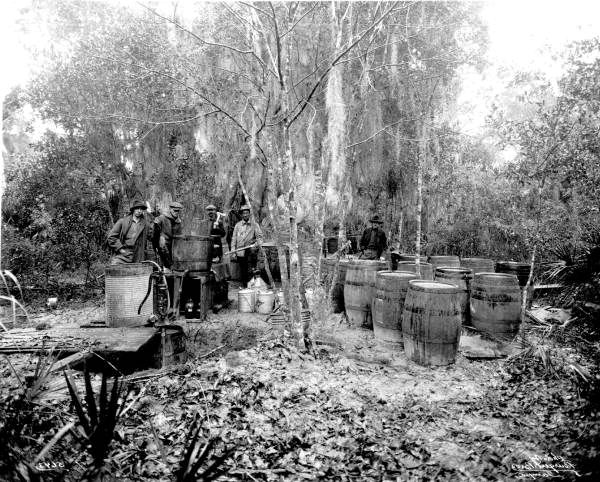

Moonshining - A matter of survival

Scenes like this across America the night Prohibition ended.

1934 Brooksville ad for the arrival of beer at Maillis Recreational Parlor on the side of the Jennings Building on South Main. Prohibition ended on December, 5, 1933 and the floodgates opened for beer all over for thirsty Americans and providing tax revenues for cities and states everywhere.

Maillis Recreational Parlor
The financial situation in Brooksville deteriorated after 1927, especially by 1929. By 1930, hard times made the paying of taxes extremely difficult, if not impossible, and by December, tax collections were off by 34% compared to 1929. Residents could not pay their power bills either. Inspectors who turned off the water for delinquent customers were confronted by folks desperate for water. By August 1930, the city's total bond debt stood at $346,200. Local finances were so bad that Brooksville Mayor P.H. Grelle suggested that the city may have to start foreclosing on house mortgages. That became unnecessary when state paramutual betting proceeding were shared in Florida with all counties in a measure that passed in 1931. In late 1933, prohibition was lifted, also bringing the windfall from liquor and gambling taxes together for a bit of relief. In Brooksville, the Depression began to subside slowly. But more help was on the way.

P.H. Grelle, Mayor of Brooksville during the 1930s
Mayor Grelle wanted to foreclose on mortgages on homes in the city who didn't pay their taxes or utilities. He was saved by paramutual betting taxes, distributed to all counties by the state.

Hernando State Bank as it looked on that fateful day of October 29, 1929
This is now Truist Bank on Main and Jefferson Streets, Brooksville. William McKethan was the president and under his guidance, the bank suffered hard times but remained solvent during the Depression. In 1939, they merged with First National Bank, absorbing First National's failed accounts.

First National Bank on Main Street (1926)
First National was one of two banks in downtown Brooksville. You could purchase stocks here on margin. Despite the efforts of bank president, Charles Price, the real estate bust sent its deposits spiraling downward. In 1929, a new president, F.B. Coogler, issued a new charter name. The First National Bank In Brooksville. Although Raymond Robins of Chinsegut Hill contributed $267,000 of his own fortune, it could not keep the bank solvent and it eventually went under on March 6, 1939.
*****
Brooksville's Recovery During The Great Depression
Brooksville's slow recovery from the Depression began in 1932, when the city received a share of the state's paramutual betting taxes which included horse racing, Jai-Alai and dog tracks. In 1934, the repeal of Prohibition generated additional taxes from beer and wine sales that helped. But workers needed jobs and paychecks. Relief could only last so long. In 1933, President Franklin D. Roosevelt began to implement The New Deal. It provided the following programs:
Fireside Chats - Roosevelt's weekly Fireside Chats on national radio outlets, NBC, CBS and Mutual spoke to the nation and gave them hope.
WPA - Works Progress Administration - Provided monies to implement new roads, infrastructure, hospitals and parks, while hiring able men and women to build them or help.
FHA - Federal Housing Administration - Provided assistance to builders and buyers through affordable payments on mortgage loans, enabling first-time buyers while stirring up the economy with hardware and furniture sales as well.
Social Security - Established Social Security in 1935, ensuring that seniors can live a life with a sense of dignity in their golden years.
AAA - Agricultural Adjustment Administration - Helping farmers and growers achieve their goals.
NIRA - National Industrial Recovery Act - was a sweeping 1933 New Deal law designed to stimulate economic recovery. It suspended antitrust laws to allow businesses to create "codes of fair competition" and established labor protections, including the right to bargain collectively. The Supreme Court declared it unconstitutional in 1935. NIRA helped build a new hospital and public swimming pool in Brooksville.
1924 - 1927
Florida Land Boom and Bust!
In the 1929 Marx Brothers movie, The Cocoanuts, Groucho Marx plays the desperate, fast-talking owner of a struggling Florida resort during the 1920s land boom. While he schemes to sell questionable real estate and woo a wealthy dowager, his partners-in-crime (Harpo and Chico) wreak havoc, inadvertently thwarting a plot to steal a diamond necklace. Part of his sales pitch is "You can have any kind of a home you want. Why, you can even get stucco. Oh, how you can get stucco!"
Groucho Marx in 1929's The Cocoanuts
Florida land investments had become a joke by then. Locally, the land boom began around 1924 and continued through 1927 with proposed developments and communities like Garden Grove, Nobelton, Masaryktown, Mundon Hill Farms, Weeki Wachee Springs and Hickory Hill. The boom began to fizzle in late 1926. A big freeze along with half-baked real estate promotions and construction disillusioned the dreams of many investors and soon buyers began withdrawing their money, thus creating a statewide land panic and depression. By 1927, it was over. It proved to be a dress rehearsal and preview for the stock market crash. Florida real estate at the time seemed like a house of cards.

*****
How We Lived
The Depression in the early 1930s brought families and neighbors together. Obviously, it took a lot less to satisfy people's needs compared to today. The late Frasier Mountain recalled "They laid many people off their jobs and had trouble paying their mortgages, lights or water bills. But neighbors helped each other. They invited them over and shared things like vegetables or produce like corn, peas, potatoes, tomatoes and fruit. Beef was a rarity. Many people had hogs and chicken for meat. They would can their own vegetables or fruit and preserved things like peas, apples, figs. Most of the people who did live outside of Brooksville came to town maybe once a week or sometimes only once a month for staples. Usually everything else was right on the farm or garden or the corner general store. There were peddlers who usually sold fish or produce. You could hear them coming up the road and people would be ready to buy their wares. Grocery stores were usually frequented by folks who walked or rode a bike to town. Back then everything was centrally located downtown. There wasn't as much need for an automobile like today. If you were lucky enough to own one car or truck per family. Most folks drove old Model T's that never went faster than 35 mph. I would pick strawberries and sell them to Mr. Springstead at his market."

Local fish delivery truck (1932)
Residents outside the city would purchase fish or produce from trucks like these that made regular weekly routes.

Brooksville mother and daughter (1932)

R. C. and a Moon Pie ...
The workingman's lunch
Originally started in 1917 with the Chattanooga Baking Company when a salesman asked one of the workers in the area what kind of snack would they like. A worker responded he'd like "a snack as big as the Moon and affordable too." So the bakery came up with the Moon Pie, which became a southern staple during the 1930s and the Great Depression. For only one thin dime, you could get a Moon Pie along with a R.C. (Royal Crown) Cola. It provided many workers with enough energy to finish the day, and worked its way into southern folklore.
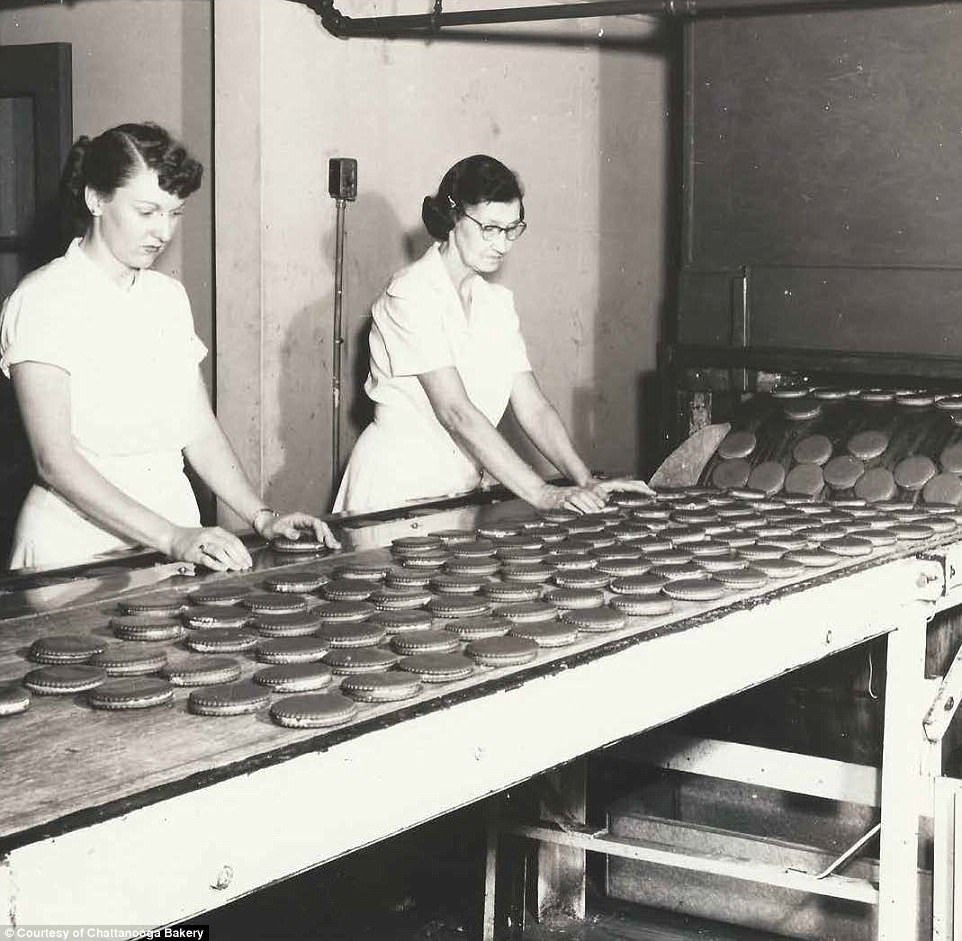
Moon Pie Assembly Line
"SPEED IT UP"

Thrifty News!
1932 ad for All-American Food Store on South Main near where the Bistro is today. It would later become Publix in Brooksville in 1949 on old N. Brooksville Avenue following the purchase of All-American Stores by Publix in 1945.
*****
The Man Who Led Us Into
The Stock Market Crash and
The Great Depression
Charlie "Sunshine Charlie" Mitchell
It was an incredible time in American history. America had the most exciting and prosperous decade in its history during the 1920s and yet it all came cashing down like a giant plane carrying millions of consumer dollars and then asked to clean up the mess on their field of broken dreams. "Who's responsible for this!" many asked. The answer it appears was Charlie "Sunshine Charlie" Mitchell.

Charlie "Sunshine Charlie" Mitchell
Charlie Mitchell was born in Massachusetts in 1877 to a father who worked in produce. Charlie graduated from Amhurst College in 1899 and worked in Chicago at Western Electric, then New York in 1903, where he started an investment firm and eventually worked his way to President of National City Bank (now Citibank). In 1921 he came up with the idea of offering stocks to the average worker. The stock market had always been relegated to the very rich in their closed, smoked-filled rooms with men smoking big cigars, but now Mitchell decided that he would go nationwide and around the world selling stocks on CREDIT to everyone, including marginal buyers, offering as much as $10 to every $1 paid. It created a market-buying frenzy. It was the cool thing to do. Now you had respect and were playing with the big boys. But it was impossible to sustain this growth when stocks were worth up to 10 times more than its equity value. People were overextended too with other credit as well for everything.
After the crash in 1929, it was different. Americans had lost confidence and a run on the banks resulted. We no longer trusted banks or politicians and had to learn how to survive. It led to a great Depression. It wasn't overnight, but slowly it left a lot of uncertainty and doubt when only a few years earlier our futures seemed so bright.

The new Hernando County Hospital (1936) was on Broad Street and was built thanks to land donated by local banker William McKethan and state and federal funding through the WPA, which also hired many construction workers.

Hickory Hills Country Club
In 1926, the Florida land boom was in full bloom, bringing new developments with gold courses. This is Hickory Hills Country Club near Spring Lake. The grand opening in 1926 was a major event, bringing golf pro Walter Hagen playing an exhibition match. Hagen was a U.S. Open and British Open winner. By 1927 the land boom bombed and by 1929, the course was history.

A 1933 letter from President Franklin D. Roosevelt to Brooksville State Senator Hugh Hale thanking him for a box of tangerines from Brooksville.

A rare photo of the City Pool (1938) located on Bell Avenue. This was a WPA project that provided recreational activity and fitness for Brooksville's youth. After World War II, the pool was closed forever.

Comments