
Before The Mouse

Local Tourism Before Disney - Part 1

Before The Mouse is a brief essay of life in our area and throughout the state before two of the most influential economic developments that changed the face of tourism in Florida forever, and all during a ten-year span of time. Read the fascinating account of how it really changed Florida forever.
Stories by Robert Martinez
Before The Mouse
It had to happen. It was too good to be true. The pristine, unspoiled beauty of Central Florida and the Nature Coast would sooner or later give way to progress, new arrivals and developments. It is amazing to note that within a span of less than ten years (1963-1971), Florida would experience one of the biggest economic transformations in its history since the railroad in the 1880s. Thanks to two major developments, the completion of Florida's interstate system and Disney World, tourists would begin shying away from towns on US 41, 98, 301, 19 etc. and its smaller attractions, mom and pop motels and restaurants in favor of super highways, nationwide hotel/restaurant chains and theme parks. It was not just Disney World either. What started as a small attraction at Tampa's Anheuser-Busch facility in 1959 with tours of its brewery along with a free cup of beer would eventually become Busch Gardens.

Florida orange grove (1960) Scenes like this were quite common between Brooksville and Orlando before freezes and developments.
Walt Disney began scouting for a prime location for his proposed theme park as early as 1963, flying over Central Florida, including Hernando County, and ultimately settled around the Orlando area because of its interstate construction, the Florida Turnpike and Orlando Airport (McCoy AFB). To avoid a burst of land speculation, the Walt Disney Company used various dummy corporations with names like AyeFour Corporation, Latin-American Development and Management, Reedy Creek Ranch Corporation and others to acquire 30,500 acres or about 48 square miles. The different companies never implied it was Disney as they purchased large and many small tracts under different names, working in secrecy with real estate agents who began making offers to landowners in April 1964. Agents were careful not to reveal the extent of their intentions. If they had known, landowners would have raised the prices of their land considerably.
The agents were able to successfully negotiate numerous large tracts of land for as little as $100 per acre. Aware that recording the first deeds would trigger public scrutiny, Disney delayed filing the paperwork until a large portion of land was under contract. Orlando Sentinel editor Emily Bavar interviewed Walt Disney at Disneyland's 10th anniversary in Anaheim, California in October 1965 and asked him if the Orlando Sentinel article acknowledging a rumor that Disney was building in Florida after many purchases was true. Bavor later said "Walt looked as if I had thrown a bucket of cold water in his face...denying the story." His reaction led Bavor to write the big story on October 21, 1965, with the headline "We Say Mystery Industry Is...Disney!" Disney then called Florida Governor Haydon Burns to confirm the story. He joined Burns on November 15th in Orlando and made it official. Disney died on December 15, 1966 of lung cancer before his vision was realized. His brother, Roy O. Disney took over the baton and orchestrated the construction. Disney World finally opened in October 1971. Roy Disney would die two months later. Original admission prices in 1971 were $3.50 for adults, $2.50 Junior (under 18), and $1 for kids under 12. Once inside, however, you had to buy tickets for rides, which would ultimately change to just one price and unlimited access.

Walt and Roy Disney (1932) and the first of Mickey's many Oscars
The face of Florida would never be the same. Hernando County especially saw a sharp decline in tourism and would re-invent itself in other ways. The calm stillness in the air was gone, and those of us who remembered would spend the rest of our lives in search of that pastoral bliss when we seemed so young and thought it would last forever.

Central Florida scene (1904) when everything was pristine and unspoiled. This is somewhere between Brooksville and Orlando when groves rolled on for miles

Tourists came from far and wide on February 21, 1922, at the Russell Street Train Depot for Tourist's Day

Tourists flocked to Bayport (1925) for the fishing. Visitors traveled from as far away as Tennessee, New York and other areas. The Bayport Hotel housed them from the 1860s to 1944.
List of Smaller Area Attractions Pre-Disney
Weeki Wachee Springs (1929 to present) Highways 50 & 19 (12 miles from Brooksville) drew tourists from all over the world. Originally just an underwater boat ride, then the new mermaid attraction in 1947 turned it into a major Florida attraction. Mermaids perform underwater, fantastic souvenir shop, and boat rides. A few movies and TV shows, including Route 66 were filmed here.
Lewis Plantation & Turpentine Still (1932-1960) On US 41, Brooksville, two miles south of town.
Fort Dodge (1962-1966) North on US 19 (5 miles north of Weeki Wachee). A wild west town concept with gunfights that was short lived. Competed with the famous Six Gun Territory in Ocala.
Homosassa Springs (1940 - present) 22 miles northwest of Brooksville. Originally began as "Nature's Giant Dish Bowl" in the 1940s and today is a state park.
Foxbower Wildlife Museum (1961-1980). On US 19 Spring Hill, south of Highway 50, with the big, pink dinosaur. Featured many animals, birds, fish and reptiles and one of the finest taxidermy displays in the nation with over 1,000 stuffed animals.
Silver Springs (1924-present). Ocala, 55 miles northwest of Brooksville. Advertised all over America, it actually goes as far back as 1860 as a tourist resort.
Rainbow Springs (1937-1974) Dunnellon, 40 miles north of Brooksville on US 41.

Before the mermaids, Weeki Wachee Springs (1934) featured glass bottom boat rides.

Lewis Plantation sign on US 41 (1938). The inappropriate attraction depicted plantation life and a turpentine still. After World War II, it slowly faded away.

Tourists take the 20 minute tour off US 41 at the Lewis Plantation (1947)

How times have changed! This is the corner of US 19 and Highway 50 (1945). Wilma Smith shows the way. Highway 50 back then was know as Fla. 15. Notice the roads are two lane blacktops. Weeki Wachee is just west of this photo.
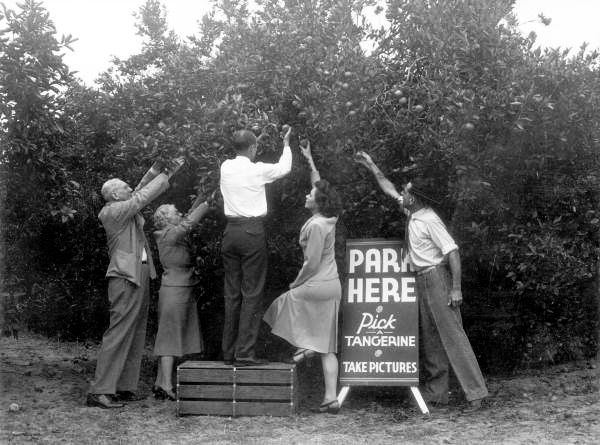
Tourists stop and pick tangerines (1946) just north of the city off US 41.

It was the dawn of a new era when the new Weeki Wachee Mermaid Attraction opened its doors for the first time in 1947. For the next 25 years it would be one of Florida's most popular destinations.

Highway billboard (1958). Billboards like this advertised all over the state.

They came from all over the nation (1959) and from Canada to Kashmir to see the mermaids.
Weeki Wachee Mermaid Circus (1960)

Zany underwater antics at Weeki Wachee (1965)
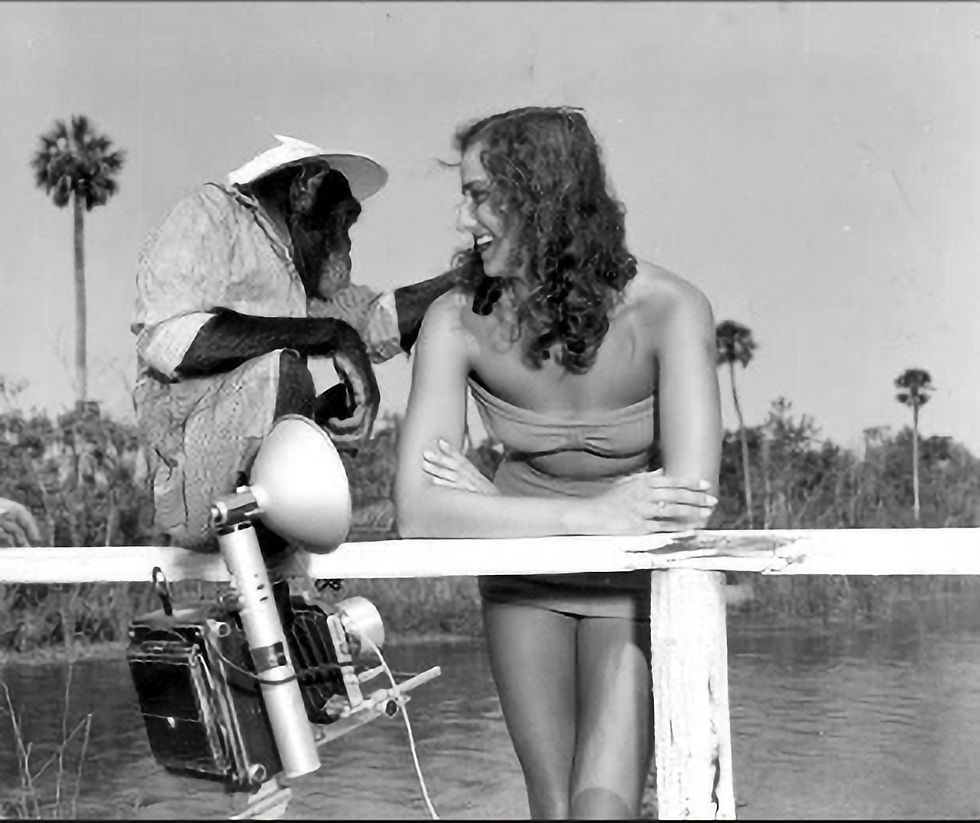
More monkey business at Weei Wachee (1961)

One of the area's most popular destinations was Ferris Groves (1959) in Floral City, 15 miles north of Brooksville on US 41. Tourists flocked there during the 50s and 60s. Ferris sent tons of packages of oranges, tangerines and grapefruit all over the nation. Advertising on billboards all over the state including the one as you crossed the bridge on Broad Street (US 41) for three decades

Tourists remember the dinosaur landmarks on US 19 (above). As a mascot for Sinclair gas station around 1958 (top) and how it looked in the 1990s (bottom)

Originally built for the Foxbower Wildlife Museum in 1961, this dinosaur is just down the road for the other one.

Two young ladies pose in 1962 at the Fort Dodge attraction, located on US 19 about three miles north of Weeki Wachee. Fort Dodge was a western theme park like Six Gun Territory in Ocala with a replica old west town, saloon and jail. The idea of promoter Paul Bostein, who convinced several local investors to open the attraction that lasted from 1962 until its closing in 1966. Soon after closing, virtually everything on the 30 acres was stolen or vandalized.


Comments